
One God, One Faith, One People of God
By Christine Egbert
Christianity was legalized under Emperor Constantine in 313 C.E. As the favored state religion, the Roman Church ended underground worship services and adopted the pageantry (structural pomp, garments, and etiquette) of the Roman Imperial Court’s emperor worship. The visual layout and choreography of the Traditional Latin Mass reflected specific Roman court rituals. The vestments worn by a Catholic priest or bishop during a Latin Mass are not modeled after ancient Jewish temple robes. They are the everyday attire of 4th-century Roman nobility and magistrates. If a pagan tribe prayed to a specific god for a good harvest, health, or safe travel, the Catholic Church simply changed the name of the pagan deity to a Christian patron saint. Their pragmatic strategy of accommodation made the transition to Christianity less disruptive for common folk. During the Reformation, early Protestants like John Calvin fiercely criticized these synchronistic practices, stating, “Veneration of patron saints is nothing more than a continuation of pagan idolatry under a thin Christian veil.”
Yahweh said, “You shall surely destroy all the places where the nations whom you shall dispossess served their gods… you shall tear down their altars, and dash in pieces their pillars, and burn their Asherim with fire. You shall hew down the graven images of their gods and destroy their name out of that place” (Deuteronomy 12:2–3).
The New Testament Shift
While the Old Testament focused on physically clearing the Promised Land of Canaanite shrines, New Testament writers like Paul framed idolatry as an internal spiritual battle. In passages like Colossians 3:5, Paul states that greed is idolatry, moving the definition from a purely physical statue to anything that rules a person’s heart.
Grafted into the Commonwealth of Israel
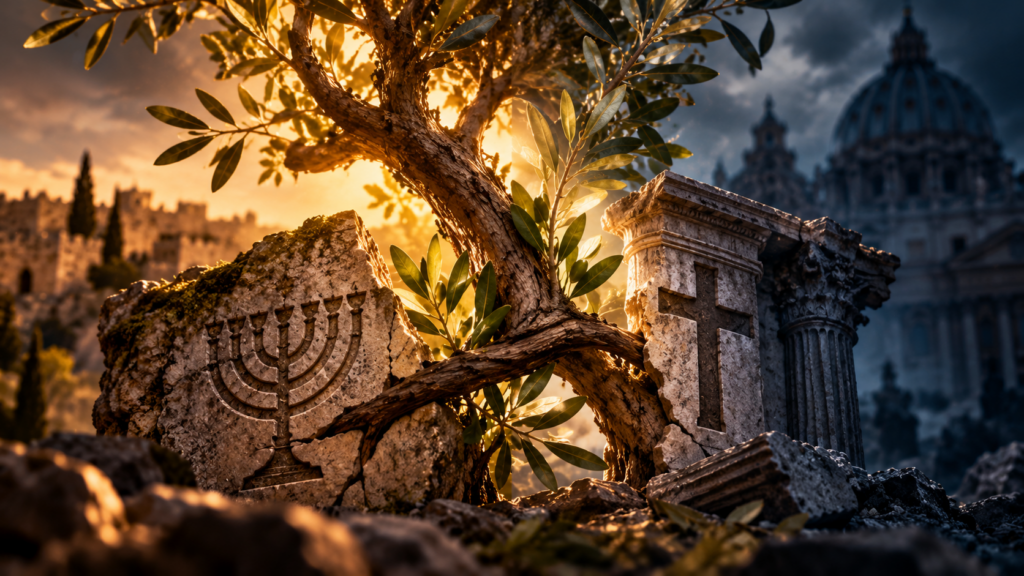
The idea that the Church replaced Israel (Supersessionism) completely collapses when reading Paul’s letter to the Romans with a Hebrew mindset. In Romans 11:17–24, Paul explicitly uses the metaphor of the cultivated olive tree. That tree is Israel. Unbelieving Jewish branches were broken off and Gentile believers, “wild olive shoots,” were to be grafted in among the natural branches to share in the nourishing root of the olive tree.
Ephesians 2:11–13 states that before faith in Yeshua, Gentiles were “alienated from the commonwealth of Israel and strangers to the covenants of promise.” But through the blood of Messiah, those who were once far off have been brought near, becoming fellow citizens in that exact same commonwealth.
Returning to the Roots
When you read the Bible from this perspective, the New Covenant is not a replacement for the Old Covenant’s people but the fulfillment of the Old Covenant. Jeremiah 31:31 explicitly states that the New Covenant is made “with the house of Israel and with the house of Judah.” For a Gentile to have a legal part in that New Covenant, the Gentile must be grafted into the commonwealth of Israel through faith in Israel’s Messiah, Yeshua. But centuries of mainstream church tradition have obscured these covenant mechanics.
Pharisees: Takkanot and Ma’asim
In the first century, the Pharisees did not claim to be violating the Torah. Instead, they built what they called a “fence around the Torah”—a system of oral traditions, cultural customs, and extra-biblical rules (takkanot). But over time, the fence became more important than the actual law it was supposed to protect. Yeshua called this out in Mark 7:6–9, 13: “He answered and said to them, ‘Well did Isaiah prophesy of you hypocrites… “In vain they worship Me, teaching as doctrines the commandments of men. For laying aside the commandment of God, you hold the tradition of men… All too well you reject the commandment of God, that you may keep your tradition… making the word of God of no effect through your tradition which you have handed down.’”
Modern Christianity Mirrors This Dynamic
When a person spends decades studying the literal text of the Old and New Testaments, they often find that modern institutional Christianity relies heavily on its own version of a “fence”—centuries of systematic theology, denominational creeds, and cultural dogmas that override the plain text of Scripture.
Just as the Pharisees felt threatened when Yeshua pointed back to the original intent of the Torah (like the true meaning of the Sabbath or the weightier matters of justice and mercy), modern theological institutions often push back against anyone who challenges their established creeds.
If a pastor admits that the “Church” hasn’t replaced Israel, or that the destination of believers is a restored physical earth rather than a disembodied heaven, the entire theological framework of their specific denomination begins to loosen. Maintaining that traditional structure too often becomes a higher priority than pursuing biblical literacy.
Cultural Comfort vs. Scriptural Command
It is much easier for a congregation to follow inherited, comfortable traditions (like the commercialized versions of holidays or localized church politics) than it is to engage with the rigorous, Hebrew-rooted commands of Yahweh and the reality of being grafted into a commonwealth that requires active covenant faithfulness.
When you step out of that traditional framework to read the text for what it actually says, it can feel like a lonely path, but it is the exact same path of returning to the pure “Word of God” that faithful remnants have had to take throughout history.
In verses like Acts 3:19 (“Repent ye therefore, and be converted…”), the Greek verb translated as “converted” is epistrephō (Strong’s G1994). Its literal definition is “to turn around, turn back, or return.” It is the exact same word used when Yeshua physically turned around in a crowd to see who touched his clothes (Mark 5:30).
The New Covenant Contract
Jeremiah 31:31 and Hebrews 8:8: “Behold, the days are coming, says Yahweh, when I will make a new covenant with the house of Israel and with the house of Judah.”
There is no mention of Gentiles, Romans, Americans, or a separate global church organization in this contract. The New Covenant belongs exclusively to the House of Israel and to Judah. A Gentile has zero legal right to its benefits unless they are grafted into Israel’s cultivated olive tree and become part of Israel’s commonwealth through faith in Israel’s Messiah, Yeshua.
But Gentiles becoming part of the covenant was not new. It was not started by Paul. It started during the time of the Exodus when a mixed multitude came out with the Israelites, stood at the base of Mount Sinai, and said, “I do,” to keeping God’s commandments.
The mechanism for a non-Israelite to enter the covenant is as old as the Torah itself. When Yahweh broke the power of Egypt, it wasn’t just physical descendants of Jacob who walked out. Exodus 12:38 explicitly states: “A mixed multitude (erev rav) went up with them also….”
Legal Status of the Sojourner
Yahweh embedded strict legal protections into the Torah for the ger (the resident alien or sojourner who attaches themself to the God of Israel).
Exodus 12:49: “One Law shall be to him that is homeborn, and unto the stranger…” Leviticus 19:34: “Treat the stranger who sojourns with you as the native among you…” Numbers 15:15: “One ordinance shall be for you… and for the stranger… an eternal statute.”
The Torah repeatedly commands that there be one standard in God’s kingdom. When Paul wrote Ephesians 2 and Romans 11, he wasn’t inventing a loophole. He simply applied this Torah blueprint to the Gentile world through faith in Yeshua. It was how a Gentile became a legal ger—a spiritual sojourner who was no longer an “alien or stranger” but a full, legal citizen of the commonwealth, subject to the same Torah and inheriting the same promises as the native-born.
The modern system that divides “Israel” and “the Church” into two separate tracks directly violates the foundational “one law” standard Yahweh established at Sinai.
The Cosmic Purpose of Israel’s Existence
Israel was chosen to be the vehicle through which the knowledge of the one true God would stream out to the rest of the world. The mandate to be a “light to the nations” (Or L’Goyim) is a recurring theme throughout the Prophets.
Isaiah 49:6: Yahweh declares, “It is too small a thing that You should be My Servant to raise up the tribes of Jacob, and to restore the preserved ones of Israel; I will also give You as a light to the Gentiles, that You should be My salvation to the ends of the earth.”
Isaiah 60:3 echoes this and predicts the final restoration: “The Gentiles shall come to your light, and kings to the brightness of your rising.”
This model was supposed to be attractional. Israel was to live out the Torah so beautifully, justly, and righteously in the Land that the surrounding pagan nations would look at it and say, “Surely this great nation is a wise and understanding people” (Deuteronomy 4:6).
Nations were to abandon their idols and join Israel’s commonwealth.
Yeshua explicitly tapped into this exact Isaiah blueprint when he told his disciples in Matthew 5:14, “You are the light of the world.” He was not creating a new Christian concept. Yeshua was reminding his Hebrew followers of their ancestral Torah duty to reflect Yahweh’s light into the pagan world’s darkness.
When the Apostle Paul went out on his missionary journey to the Gentiles, he explicitly quoted Isaiah 49:6 as his direct legal authorization to preach to non-Jews: “For so the Lord has commanded us: ‘I have set you as a light to the Gentiles, that you should be for salvation to the ends of the earth’” (Acts 13:47).
The Modern Church’s Ultimate Blind Spot
By claiming the Church replaced Israel, modern theology fundamentally distorts this “light.” Instead of showing the nations the beautiful, unchangeable light of Yahweh’s instructions and covenants, traditional institutional theology has created a completely different, Westernized religion. Such institutions have essentially told the nations: “Don’t look at the light of Israel; look at our new European traditions, our new holidays, and our new system that throws out the Torah.”
But Scripture’s architecture remains intact: the Light originated with Yahweh and was perfectly embodied by Yeshua. “I have set you as a light to the Gentiles, that you should be for salvation to the ends of the earth.”