
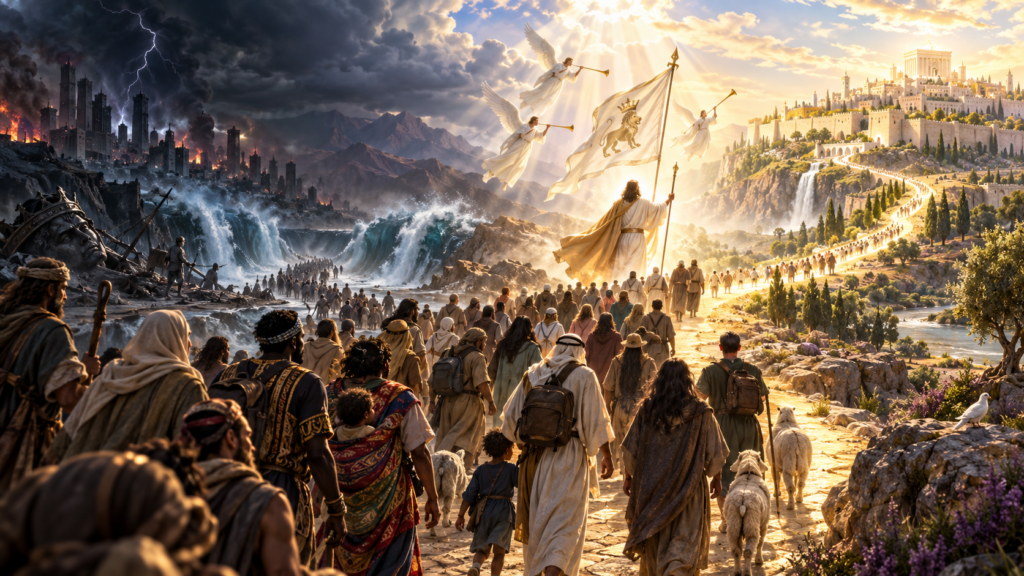
Timeline of the Greater Exodus
by Christine Egbert
Although most scholars and students of prophecy agree about what happens during the Greater Exodus, they fall into three main categories regarding when these things take place. Do they occur before or after Israel’s Messiah returns and establishes His 1,000-year Millennial reign? The three views of the timeline are as follows:
- The Pre-Wrath Tribulation Gathering
- The Post-Tribulation/Second Coming Event
- The Millennial Process
View Number One:
The Pre-Wrath Tribulation Gathering
Proponents of the Pre-Wrath view see the Greater Exodus beginning during the Great Tribulation, when God gathers His people out of the global system of Babylon as it begins to collapse and opens a highway so the remnant can escape the Antichrist’s wrath. They cite Revelation 12:14, where the woman (Israel) is given wings to fly into the wilderness and is supernaturally nourished for 3.5 years. They also cite Ezekiel 20:35, where God says He will bring believers into the “wilderness of the peoples” and plead with them face-to-face before they enter the Promised Land. According to this view, the remnant arrives in the Land just as Yeshua descends to rescue Jerusalem.
View Number Two:
The Post-Tribulation/Second Coming Event
The Post-Tribulation/Second Coming view—based on Isaiah 11—is popular among Messianic and Premillennial scholars. Its proponents see the Greater Exodus occurring immediately after the Messiah returns, strikes the earth with the rod of His mouth, and slays the wicked with the breath of His lips (Isa. 11:4). This view connects the banner (nes) of Isaiah 11:12 with the great trumpet Yeshua spoke of in Matthew 24:31: “And He will send His angels with a loud trumpet call (teruah in Hebrew), and they will gather His elect from the four winds, from one end of the heavens to the other.” This verse mirrors Isaiah 27:13, which says, “In that day, a great trumpet will sound, and those perishing in Assyria and Egypt will return.” In this view, the Greater Exodus is an instantaneous event triggered by the appearing of the Messiah, the resurrection of the Dry Bones (Ezekiel 37), and the flight on the highway for the remnant of His people (Isa. 11:16).
View Number Three:
The Millennial Process
This perspective suggests a gradual regathering of God’s people from the four corners of the earth during the early decades of the Millennial Kingdom. Yeshua returns, defeats the nations that come against Israel at Armageddon, and establishes His throne in Jerusalem. When the Lord issues a global decree for all the scattered tribes to return, Gentiles bring them back as an offering from all the nations, as described in Isaiah 66:20.
Where I Stand
After considering all three views, I believe view number two is the most accurate. Isaiah 10:25 says, “For in a very little while My indignation against you (Israel) will be spent, and My anger will be directed toward their destruction”—that is, the destruction of the nations that came against Israel.
Then Isaiah 11 lays out the sequence. Verses 1–3 speak of Yeshua as the Righteous Branch who springs forth from the stump of Jesse and judges with righteousness in the Millennial Kingdom. Verses 4–5 describe Yeshua striking the earth with the rod of His mouth, slaying the wicked with the breath of His lips, and wearing righteousness and faithfulness like a belt. This language echoes Revelation 19:15 and 19:21, where a sharp sword proceeds from His mouth to strike the nations and slay His enemies.
Verses 6–9 describe the peace and righteousness of His reign, while verse 10 says, “Then it will happen on that day” when the nations rally to the Root of Jesse. Verse 11 continues: “The Lord will set His hand a second time to recover the remnant of His people.”
The words “second time” deliberately invite comparison with the first Exodus. But this deliverance is greater in scope because the scattered are gathered not from one nation, but from Assyria, Egypt, Pathros, Cush, Elam, Shinar, Hamath, and the islands of the sea.
Islands of the Sea
The Hebrew word translated “islands” can also refer to coastlands or distant maritime regions. From Isaiah’s vantage point, the phrase reached beyond the familiar lands surrounding Israel toward places across the sea. I believe this broad prophetic expression can include distant lands such as America, but the text does not name America specifically. Isaiah’s point is larger: no ocean and no distance will place any part of the remnant beyond the Lord’s reach.
Verse 12 makes the worldwide scope unmistakable. The Messiah raises a banner for the nations, gathers the outcasts of Israel, and assembles the dispersed of Judah from the four corners of the earth. This is not a return limited to the ancient Near East. It is a global recovery of God’s covenant people.
Judah and Ephraim Reunited
Before the highway is opened, Isaiah 11:13 says the jealousy of Ephraim will depart and the hostility of Judah will be cut off. The two houses will no longer vex one another. This restoration is more than geographic. The Greater Exodus reunites a people divided since the days of the kings. Ezekiel 37 presents the same truth through the two sticks of Judah and Joseph becoming one in the Lord’s hand.
Why Are Enemies Still Subdued?
At first glance, verse 14 may appear out of place. If Yeshua has returned and the nations are already rallying to Him, why do Judah and Ephraim swoop down on Philistia, possess Edom and Moab, and bring Ammon into subjection? The answer is that the Messiah’s Kingdom begins with both submission and judgment. Some survivors among the nations seek the King and learn His ways; others continue to resist His righteous rule and must be subdued.
The nations named in verse 14 surrounded Israel on the west, east, and southeast. They represent the immediate human barriers around the Land. In the first Exodus, hostile neighbors could block Israel’s passage. In the Greater Exodus, no such opposition will be allowed to prevent the remnant from reaching its inheritance. The King first unites Judah and Ephraim; then, under His authority, they overcome the enemies that stand in the way.
The Highway Opens
After the human barriers are removed in verse 14, the Lord removes the natural barriers in verses 15–16. He dries the tongue of the Egyptian Sea and divides the Euphrates so His people can cross in sandals. Then Isaiah states plainly: “There will be a highway for the remnant of His people… as there was for Israel when they came up from the land of Egypt.” The sequence is deliberate. The Messiah reigns, the people are reunited, hostile powers are subdued, waters are divided, and the highway opens.
This Pattern Has Been Foreshadowed
The modern restoration of Israel provides a striking foreshadowing of this final work. After centuries of dispersion and persecution, the State of Israel was declared in 1948. Isaiah 66:8 asks, “Can a nation be born in a day?” While modern Israel does not exhaust that prophecy, its sudden national restoration demonstrates that the God of Israel is able to preserve a scattered people and restore them to the Land.
Ezekiel’s vision of the Dry Bones also presents restoration in stages. The bones come together and receive sinews and flesh before the breath enters them. In the same way, the modern physical return may be viewed as a prophetic signpost pointing toward the greater spiritual and national restoration that will occur under Messiah’s reign. The present return is not the completed Greater Exodus, but it shows that what once appeared impossible has already begun.
From the River of Egypt to the Euphrates
Israel’s inheritance in that day will extend beyond the borders of the modern State of Israel. God’s covenant with Abraham promised his descendants the land “from the river of Egypt to the great river, the Euphrates” (Gen. 15:18), and Ezekiel 47–48 describes the restored tribes receiving their appointed portions under Messiah’s rule. Thus, the Greater Exodus will bring Israel not merely back to the Land, but into the fuller territorial inheritance God pledged to Abraham, Isaac, and Jacob.
Conclusion
The three views each recognize genuine elements in the prophetic passages: tribulation, the appearing of the Messiah, the trumpet call, the wilderness, and the highway. But when Isaiah 10:20 through 11:16 is allowed to speak in its own order, I believe the larger picture becomes clear. Yeshua first appears as the righteous Branch and destroys the wicked. The nations begin to seek Him. He raises His banner, recovers the scattered remnant, reunites Judah and Ephraim, subdues the enemies surrounding the Land, removes the natural obstacles, and provides a highway like the one He made in the first Exodus.
The Greater Exodus, therefore, is not an escape that culminates in the Messiah’s return. It is one of the first great works of His Kingdom—a worldwide, miraculous, and orderly homecoming that will eclipse the memory of the Exodus from Egypt and display the faithfulness of Israel’s God before all nations.
Traditional Judaism also teaches that the regathering of Israel is a work of the Messiah. Maimonides wrote that the Messianic king “will build the Temple and gather the dispersed of Israel.” He based this expectation on God’s promise in Deuteronomy 30:3–5 to gather His people from the nations and return them to the Land (Mishneh Torah, Laws of Kings and Wars 11:1).